






|
Quantity
|
Total
|
||
|
|
|||
|
|
|||
Every projector page has a throw distance calculator: enter the distance from the wall and you will see the screen size in your own room.
The catalogue is split by brightness, not by intended use: the same figure works in a large hall and on the wall of a house in the evening. Over 5,000 ANSI lumens is the range for big spaces: a hall with a hundred viewers, screens from 200″, open-air shows.
What an ANSI lumen is
ANSI is a brightness measurement protocol: readings are taken at nine points across the screen and averaged. Makers of cheap projectors do not use this protocol, so their “lumens” cannot be compared to ANSI.
Who needs over 5,000
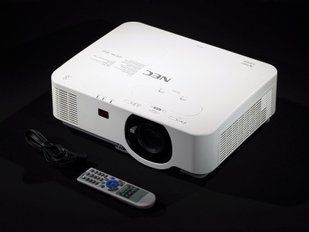
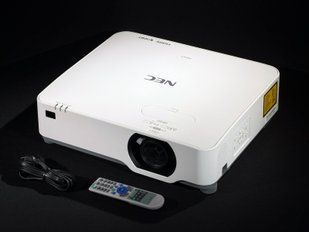
This is equipment for showing to a group of people: a film screening for 50–100 viewers, a church, a wedding, a festival, a summer cinema in the yard or on a roof, projection onto a house facade. The NEC PA653U delivers 6,500 lumens — headroom that keeps the image readable outdoors even before full darkness.
Brightness is screen size
Light is divided across the screen area. A 200″ screen has four times the area of a 100″ one — and needs four times the lumens for the same richness. That is why a screen across the whole end wall of a hall, or a house wall, starts in this range. For a room at home the ranges below are enough.
Lamp and laser are both strong here
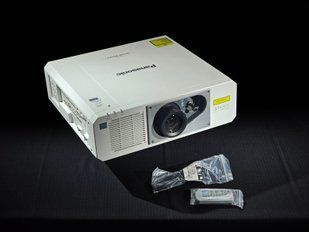
The Canon WUX6010 gives 6,000 lumens from a lamp and an LCOS panel: an image with no pixel grid and the natural colour of a continuous spectrum. The Panasonic PT-RZ570 gives 5,400 lumens from a SOLID SHINE laser with sealed, filter-free optics and 20,000 hours on the spec sheet: switch it on and forget it for years.
Workhorses built like tanks — and a sound investment
These projectors are big because a bright projector cannot be small: a powerful light source needs serious cooling. Hence the metal chassis, twin fans and sealed optics — a construction designed to run all day, for years. At home, where a projector runs two or three hours an evening, that service life stretches into decades, and eco mode takes the surplus brightness down for a smaller screen. This class holds its value: you can always sell such a machine, and sell it at a good price.
Buy once instead of renting every time
New, machines of this class cost several thousand dollars, which is why people usually rent them for each event rather than buy. The arithmetic here is different: a used projector costs as much as a few rentals — and after that every show is free. There is no cheaper substitute: an LED unit is physically incapable of covering a hall like this. 90-day warranty, pickup in Lviv, shipping with no prepayment.
Information collected by students
of the Higher Vocational School of Cinema
VPU-K © 2026